Automation · guide4 min read · published 18 October 2026
What an AI receptionist can and can’t do for a small business
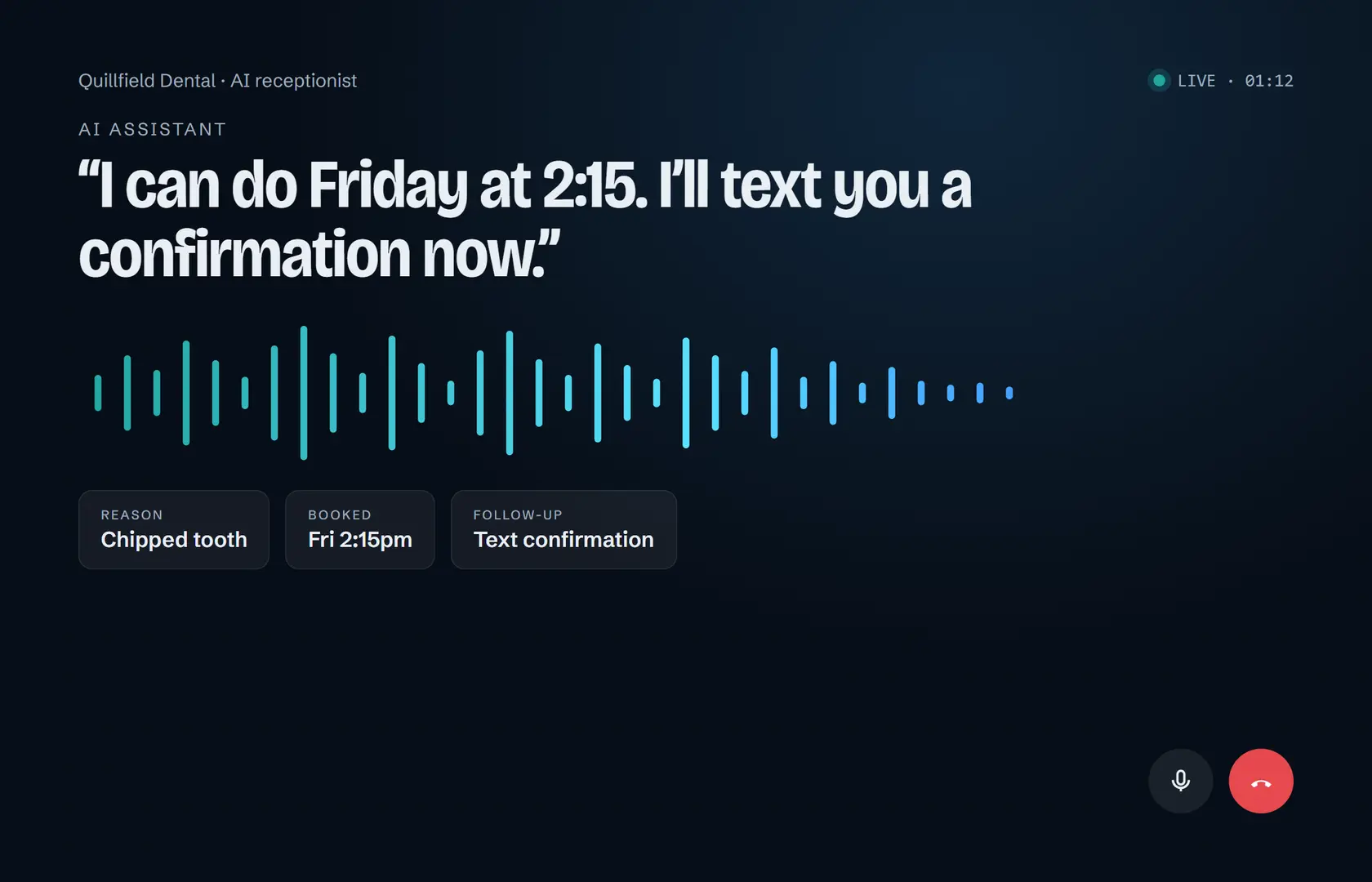
An honest look at AI phone answering for small businesses: the jobs it suits, the jobs it doesn’t, and the questions worth asking any supplier, including us.
The short answer
An AI receptionist is software that answers phone calls in a natural voice. For a small business, its useful job is narrow: pick up the calls you can’t get to, answer the routine questions, take the caller’s details and tell you who rang and why. It is not a replacement for a person who knows your customers, and it should never pretend to be one.
What it handles well
- Calls you can’t answer. Lunch, busy lines, when you’re with a customer or on a job, and out of hours. Many callers won’t leave a voicemail, so a short conversation that captures their details is often the difference between a call-back and a lost enquiry.
- Routine questions. Opening hours, services, where you are, how to book. The answers should be wording you’ve written or approved, not something the AI makes up.
- Taking details. Name, number, reason for calling and a preferred time to call back, with the number read back to the caller.
- Telling you what happened. A summary of each call, by email or text, so you can decide who to ring first.
- Booking, if your calendar supports it. Some set-ups can book into an online calendar. Check that your specific booking system is supported before you count on it.
What it shouldn’t do
- Pretend to be human. Callers should hear at the start that they’re talking to an AI, and that the call is recorded if it is. If someone asks, it should say so plainly.
- Give clinical, legal or financial advice. Clinics in particular need it to stay out of triage. Emergencies should be directed to 999, not handled.
- Take card payments over the phone. That brings in payment-security rules most small businesses don’t want an AI anywhere near.
- Handle a complaint or a distressed caller on its own. It should try to pass them to a person by rules you agree, or take their details for a quick call-back.
Limits worth knowing about
Every service has limits, and a good supplier tells you what they are before you sign. The ones that matter most:
- Minutes. Plans usually include a number of minutes a month. Ask what happens when you go over: does it stop answering, keep going at an extra charge, or take messages? Get the answer in writing.
- Call length. Many set-ups cap a single call. Ask what the cap is and what the caller hears when it’s reached.
- Phone networks. Calls depend on your forwarding and on phone providers, which can fail. No honest supplier can promise every call will be answered.
- Testing. Ask whether it will be tested on your own number, with you ringing it and asking awkward questions, before a real caller hears it.
For transparency, here is what ZAYR’s own managed receptionist does. It is set up to say it’s an AI and that the call is recorded, answer from wording you approve, take the caller’s details and email you a summary. Calls are limited to 10 minutes. You get alerts at 80% and 100% of your included minutes, and it stops answering at 150% of them until the next month. It can pass urgent callers to your team in hours you set, and book into a supported booking system. Paid extra minutes are not available. Every setup is tested on the client’s own line before it goes live. The packages are on the AI receptionist page.
Data protection
Call recordings and summaries are personal data. Under UK GDPR you are normally the controller and the supplier is your processor, so you should expect a data processing agreement, a clear answer on where recordings are stored and for how long, and help updating your privacy notice. Clinics will usually need a data protection impact assessment (DPIA) as well.
Questions to ask any supplier
- Does it say it’s an AI at the start of every call?
- Who writes and approves the answers it gives?
- What exactly happens when I run out of minutes, and when a call hits the time limit?
- Can it pass a caller to a person, and what happens if nobody picks up?
- Which booking systems has it actually been connected to?
- Will it be tested on my number before it goes live?
- Where are recordings stored, for how long, and will you sign a data processing agreement?
- What is the minimum term, and what notice do I give to leave?
Is it right for your business?
It tends to suit businesses that take enquiries by phone and can’t always pick up: clinics, salons, trades, garages and agents. It suits them less if most calls need judgement, if callers are often upset or vulnerable, or if you already answer nearly every call yourself. If you’re not sure, it’s worth counting how many calls you miss in a typical week, and when, before you spend anything.